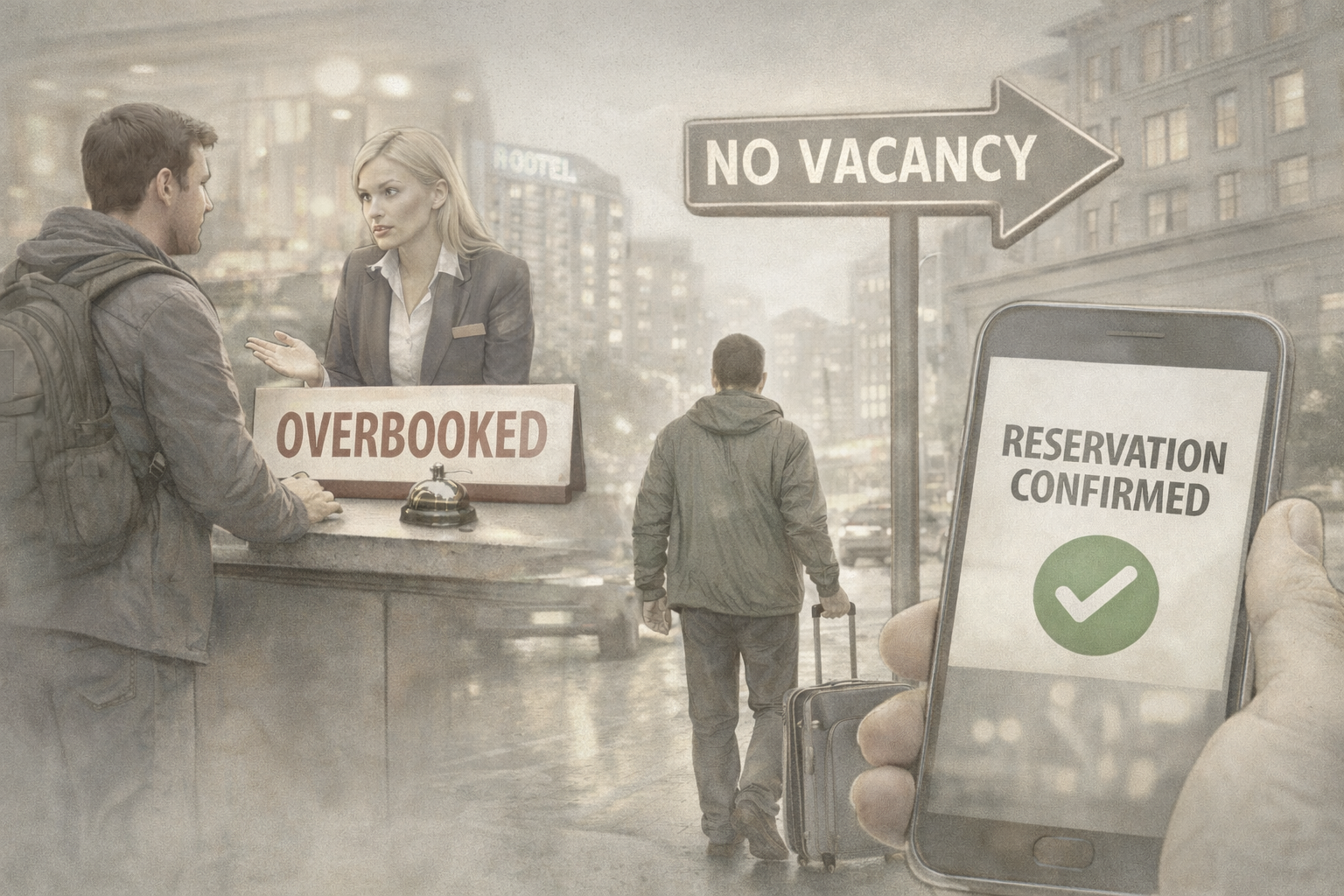
You booked the room.
You have the confirmation email.
Your card was charged.
So how can a hotel still say:
**“We’re walking you.”**
If you travel enough — especially during events, peak weekends, or flight disruption nights — you’ll eventually meet the quiet practice hotels use to manage risk: **overbooking**.
And yes — it’s legal.
But being “walked” isn’t random. It’s strategic.
Which means you can reduce your odds dramatically.
Let’s break it down.
What “Walking” Actually Means
When a hotel is oversold, it may send (or “walk”) a guest to another nearby property, typically covering:
* The first night’s room
* Transportation (sometimes)
* The rate difference (sometimes)
Major brands like Hilton, Marriott International, and Hyatt Hotels Corporation have internal policies requiring this under certain circumstances.
But here’s the part they don’t advertise:
They don’t choose randomly.
They choose strategically.
Why Hotels Overbook in the First Place
This isn’t incompetence. It’s math.
Hotels operate on **yield management models**, similar to airlines. If 8–12% of guests historically cancel or no-show, revenue systems will oversell by that margin.
Why?
Because empty rooms can’t be stored and sold tomorrow.
Inventory expires nightly.
So the system assumes some guests won’t show.
When too many *do* show?
Someone gets walked.
The question becomes:
**Who looks safest to move?**
How to Make Sure It’s Not You
Below are the levers you control.
1. Check In Early (Even Digitally)
The later you arrive, the easier you are to move.
* Early arrivals are “in-house.”
* Late arrivals are “numbers in the system.”
Use mobile check-in apps when available. Brands like Hilton and Marriott International timestamp digital check-ins, which signals arrival intent.
Even better?
Call the hotel around noon and confirm your arrival time.
You want your reservation marked:
> “Guest confirmed — arriving.”
That matters.
2. Join the Loyalty Program (Even at Base Level)
Hotels protect:
1. Elite members
2. Repeat guests
3. Corporate contracts
Even free membership tiers give you an internal ID.
To revenue managers, you become:
* A trackable customer
* A future revenue stream
* A complaint risk
All three reduce your odds of being walked.
3. Book Direct, Not Through a Third-Party OTA
Reservations made through third-party sites (OTAs) like Expedia Group or Booking.com often carry:
* Lower profit margins
* Harder-to-modify terms
* Less brand loyalty protection
If a hotel must choose between:
* A direct booking guest
* A discounted OTA booking
The OTA guest is statistically more vulnerable.
—
4. Avoid One-Night Weekend Stays During Major Events
High-risk scenarios:
* College football weekends
* Concert nights
* Storm-disruption travel days
* Holiday Saturdays
Short one-night stays are easier to relocate than multi-night business travelers.
If possible:
* Arrive a day earlier
* Stay two nights
* Or choose business-focused properties over leisure-heavy ones
5. Use a Credit Card Guarantee (Not Just Debit)
Hotels view debit card reservations as higher risk.
Credit card guarantees signal:
* Financial stability
* Lower dispute risk
* Higher brand value
You’re subtly categorized as a lower-liability guest.
6. Confirm Same-Day (Especially If Arriving Late)
If you’re landing at 10:30 PM, call around 3–5 PM and say:
> “Hi, just confirming my guaranteed reservation. I’ll be arriving around 10:30 PM.”
This forces staff to:
* Review oversell status
* Potentially reassign risk elsewhere
* Mark your booking as high-intent arrival
You’re no longer passive inventory.
If They Still Try to Walk You
Stay calm. But know your leverage.
Ask:
1. Is the alternate hotel comparable in brand and quality?
2. Is transportation included?
3. Are they covering rate differences?
4. Will they compensate additional inconvenience?
If you’re elite with brands like Hilton or Marriott International, ask about their guaranteed walk compensation policies.
And remember:
You do not have to accept a downgrade.
The Hidden Hierarchy of Who Gets Walked
Based on industry practice, the typical vulnerability order looks like this:
Most Protected:
* Top-tier loyalty members
* Long multi-night stays
* Corporate contract rates
Middle:
* Direct website bookings
* Credit card guaranteed leisure stays
Most Vulnerable:
* OTA discount bookings
* One-night Saturday stays
* Late arrivals with no contact
* Guests without loyalty accounts
It’s not personal.
It’s math.
The Bottom Line
A confirmation number is not a force field.
Hotels optimize revenue — not fairness.
But if you:
* Join loyalty programs
* Book direct
* Check in early
* Confirm arrival
* Avoid high-risk patterns
Your odds of being walked drop dramatically.
And in travel, sometimes that’s the difference between:
A smooth check-in…
…and dragging your suitcase back into the night.
How to Stop a Hotel From “Walking” You (Even If They’re Overbooked)